
Kaypro II
Sunday, June 14, 2009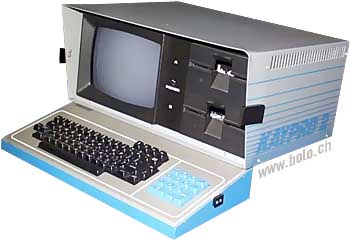 The KayproII systems were known to be square-built ! All the hardware is packed into a solid aluminum case.Despite of its weight(10kg),it was rugged, reliable, reasonably priced, looking more like instruments than the creative, communications (and business) tool that it is. It was a success in the market-with 9 inch monitor & dual floopy drive

Arthur C. Clarke lived in Sri Lanka while working on the movie version of his science-fiction novel "2010". He used hisKaypro II and a modem to keep in touch with Peter Hyams (the director) in Los Angeles.
-------------------------------------------------------------------------------
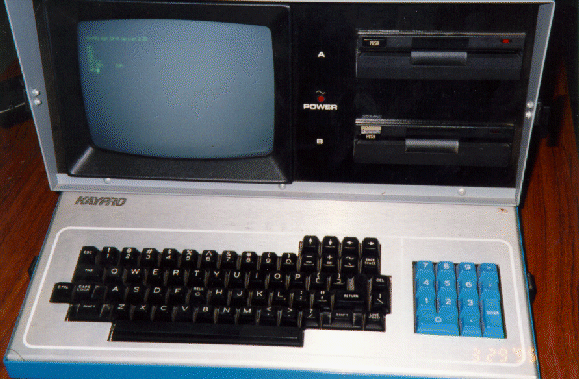
Despite its name, the Kaypro II was the first Kaypro model. The name was KAYPRO II, because the Apple II was the most popular system (besides the IBM PC) around back then, and Kaypro decided to follow in the image.
It was conceived by Non Linear Systems inc., a company with over 30 years' experience of producing small portable aerospace electronic equipment, which would later become Kaypro.
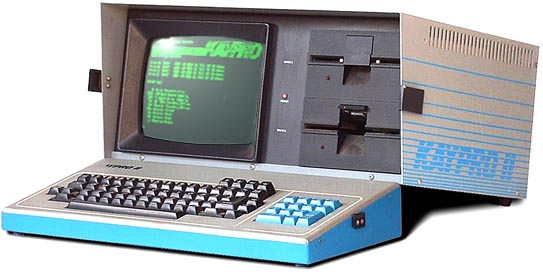
The Kaypro systems were known to be square-built ! All the hardware is packed into a solid aluminum case. These computers can resist to a lot of trouble as they proved when ten of them (Kaypro IV & 10) were used by doctors for the Paris-Dakar 84's edition. Non of them failed despite extreme conditions.
One asset of the Kaypro, over the Osborne 1 which was available at about the same time, is the 9" built-in monitor, easily twice the size of the Osborne's. Though the Kaypro 2 has no graphic features, it can display 80 x 24 characters. There are two single-sided / double-density full-heigth 5.25'' disk-drives (190k each). One can be used to boot CP/M and the other to run the software.
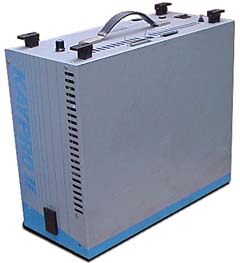
The Kaypro II is a real "luggable" system. Even if it weights more than 10kg, it can be easily moved with the handle found at the back.
At the rear of the system, one can find a serial port, a parallel port, a keyboard connector, a brightness control knob and reset button.
Perfect Writer, Perfect Calc, Perfect Filer, Perfect Speller, S-Basic, CP/M and Profitplan were bundled with the system. Later WordStar was also available.
As usual with Kaypro, the model names logic is quite dramatic to resolve. Several Kaypro "2" were marketed :
- In 1984 a new Kaypro 2 (refered as Kaypro 2'84) is introduced. It has two SS/DD half-height floppy drives, a Z-80A running at 4.0 MHz, 2 serial ports and rudimentary graphics (through graphic characters).
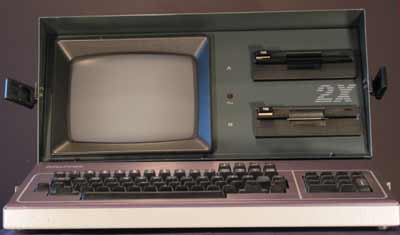
- The same year, the Kaypro 2X is released. Very similar to a Kaypro 2'84 but with DS/DD half-height drives.
- Still in 1984, in order to be compatible with IBM software, a special version was marketed with an Intel 8088 CPU instead of the Z80A. It was called the Kaypro II Plus 88!
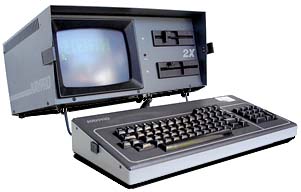
- In 1985 another Kaypro 2 refered as "New 2" is sold. It is basically an old 2X motherboard, with one or two DS/DD floppy drives, but no 300 baud modem previously found on the 2X. It comes with just CP/M and Wordstar for software.
- And to spice up a bit things, Kaypro decides to rename its Kaypro 4'84 as Kaypro 2X (sometimes also known as 2X MTC), thus dropping the previous 2X model!
Name: Kaypro II
Manufacturer
Kaypro Division
Non-Linear Systems Inc.
533 Stevens Ave.
Solana Beach, CA 92075
(619) 755-1134
Dimensions
Folds to an 18- by 8- by 15 1/2-inch suitcase-like metal box with a handle; weighs 26 pounds
Components
A Zilog Z80 microprocessor running at 2.5 MHz; 64K bytes of dynamic RAM and 2K bytes of screen memory; an 80-column by 24-line green-phosphor display with brightness control; a selectric-style keyboard with numeric keypad; two single-sided, double-density 5 1/4-inch drives, each with a capacity of 193K bytes (formatted); RS-232C serial and Centronics-compatible parallel ports
Software
CP/M 2.2; the Perfect Software family: Perfect Writer (word processor), Perfect Files [database), Perfect Calc (spreadsheet), Perfect Speller (spelling checker), tutorial disks; The Word Plus (Spelling checker); Profitplan (spreadsheet); MBASIC (Interpreted BASIC with Games); S-BASIC (structured, compiled BASIC); system utilities.
Documentation
System manual; standard CP/M manual; Perfect Software manuals; The Word Plus and Profitplan manuals, S-BASIC and MBASIC manuals (language descriptions)
Price
$1595
Options
Vinyl and nylon cases
Osborne 1
Saturday, June 13, 2009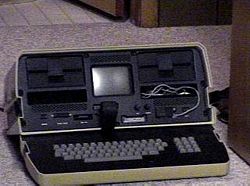
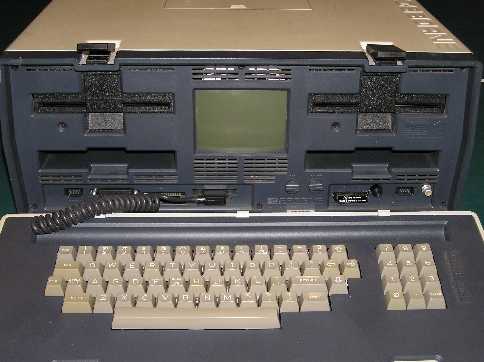
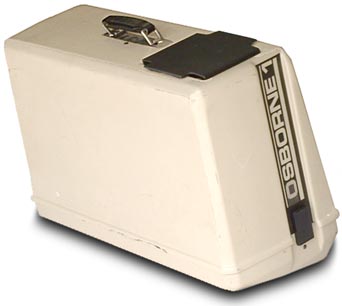
I can confirm that this is one of the first ten prototype units built, known as the "metal case" units. I don't think they had serial numbers. The cases were made by Galgon Industries in Hayward but their quote for production was prohibitive, so work immediately commenced on the plastic cases. The circuit board was ready in January of 1981 and these were built shortly thereafter. They were used in the first ads ("the guy on the left doesn't stand a chance") in which the veins on the hand of the guy on the right bulge as he struggles with the 30-pound weight of his transformer-powered luggable. These were the units we took to the West Coast Computer Faire and the National Computer Conference in early 1981.
Software
The Osborne 1 was the first microcomputer that came with application software. The WordStar word processor, SuperCalc spreadsheet, and the CBASIC and MBASIC programming languages—all software packages that were the leading applications in their respective niches at the time—had a retail value of more than US$2000. The exact contents of the bundled software varied depending on the time of purchase; for example, dBASE II was not included with the first systems sold.
Hardware Specifications
Hardware features:
Dual 5¼-inch, single-sided 40 track floppy disk drives ("dual density" upgrade available)
4 MHz Z80 CPU
65 kilobytes main memory
Fold-down keyboard doubling as the computer case's lid
5-inch, 52 character × 24 line monochrome CRT display
IEEE-488 port configurable as a Parallel printer port
RS-232 compatible 1200 or 300 baud Serial port for use with external modems or serial printers
The Osborne 1 was powered by a wall plug, and had no internal battery, although an aftermarket battery pack offering 1 hour run-time was available. Early models (tan case) were 120 V only, later models (blue case) could be switched to run on either 120 V or 230 V, 50 or 60 Hz.
Games
ADVENT (Colossal Cave Adventure) running on an Osborne Computer circa 1982
Since the display of the Osborne did not support bit-mapped graphics, games were typically character based games, like text adventures (the 1982game Deadline, for example, packaged in a dossier type folder and came on two 5 1/4" diskettes.). Compiled and MBASIC interpreted versions ofColossal Cave Adventure were available for the Osborne. Some shareware games made good use of the Osborne's limited character-mode graphics.
Peripherals
These peripherals were not part of the base computer. Peripherals may have been offered by particular vendors at various times.
External Monochrome screen - using separate synch and video connections, driven by the motherboard video circuitry.
Dot Matrix Parallel Printer (Made by Star)
300 Baud Modem - fit into a diskette storage pocket, powered from the motherboard.
A small set of aftermarket vendors offered several other upgrades to the basic model, including third-party double density disk drives, external hard disks, and a battery-backed RAM disk that fit in a disk storage compartment.
Aftermarket 80-column video upgrades were available for the original 52-column-only machines.
Market life
At its peak, Osborne Computer Corporation shipped 10,000 Osborne 1 units per month. The computer was widely imitated as several other computer companies started offering low-priced portable computers with bundled software. The Osborne 1 was about the size and weight of a heavily packed suitcase; one commercial humorously pointed out that it did not quite fit under an airplane seat. As such it is now classified as a "luggable" computer in comparison to later laptop designs. The Osborne's popularity was surpassed by the similar Kaypro II which had a much more practical 9 inch (23 cm) CRT that could display the standard 80 characters on 24 lines as well as double density floppies that could store twice as much data.
Osborne Computer Corporation was unable to effectively respond to the Kaypro challenge until after the market window had closed and the day of the 8-bit, CP/M-based computer had ended. A popular myth is that sales of the Osborne 1 were hurt by the premature announcement of superior successor machines such as the Osborne Executive; a phenomenon called theOsborne effect. Later Compaq delivered a portable computer (the Compaq Portable) with a 9 inch CRT, that was software compatible with the IBM PC, making it the first PC clone.
Osborne Computer Corporation filed for Chapter 11 (Bankruptcy) in September 1983.
In brief--Osborne-1

Released in 1981 by the Osborne Computer Corporation, the Osborne 1 is considered to be the first true portable computer - it closes-up for protection, and has a carrying handle. It even has an optional battery pack, so it doesn't have to plugged into the 110VAC outlet for power.
While quite revolutionary, the Osborne does have its limitations. For example, the screen is only 5" (diagonal) in size, and can't display more than 52 characters per line of text. To compensate, you can actually scroll the screen display back and forth with the cursor keys to show lines of text up to 128 characters wide.
The Osborne was designed with transportation in mind - it had to be rugged and able to survive being moved about. That's one reason that the screen is so small - a larger and heavier screen would be more susceptable to damage.
The two pockets beneath the floppy drives work great for floppy disk storage, although the Osborne modem also fits perfectly in the the left pocket and plugs into the front-mounted "modem" port.
Designed as a true portable computer system - it can be considered airline carry-on luggage, and it will fit under the passenger seat of any commercial airliner.
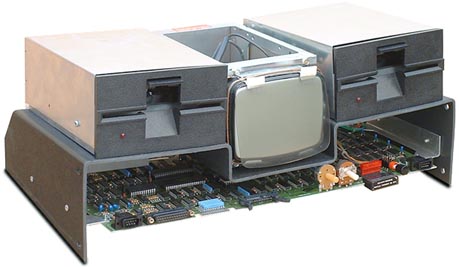
Here is the Osborne without the case - now you know the real reason the screen is so small. There's not much room left with those two full-height floppy drives.
While the Osborne was a good deal at $1795, it also came bundled with about $1500 of free software:
- CP/M System
- CP/M Utility
- SuperCalc spreadsheet application
- WordStar word processing application with MailMerge
- Microsoft MBASIC programming language
- Digital Research CBASIC programming language
- The Osborne was a huge overnight success, with sales reaching 10,000 units a month.
- In September 1981, Osborne Computer Company had its first US$1 million sales month.
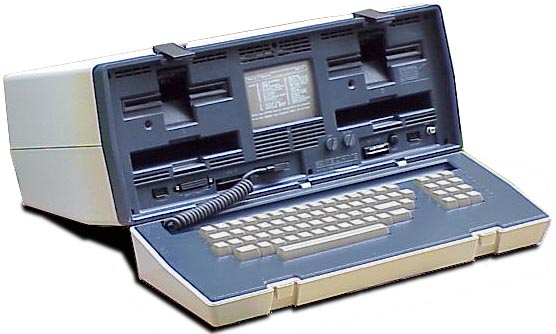
Seen below is the second release of the Osborne portable. It has a sturdier case and a slightly different look - double-density floppy-drives are optional.
Intentional or not, the "new" Osborne has a very military-like appearance, with its square face, dark blue color, and its many knobs and compartments.
In 1982, the Osborne Computer Company announced a successor, the Executive model OCC-2 (seen here to the below), with a larger screen and a cooling fan.
Shortly thereafter, they announced the next system, the Vixen, a portable running the CP/M operating system.
Unfortunately, potential customers stopped buying the Osborne 1, waiting for the Executive and the Vixen,
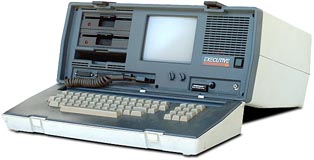
which wasn't even ready to ship yet. Additionally, the new Kaypro II was now available with a larger screen for less money. Osborne sales plummeted and Osborne quickly ran out of money and filed for bankruptcy in September of 1983.
NAME OSBORNE 1 MANUFACTURER Osborne Corp. TYPE Transportable ORIGIN U.S.A. YEAR 1981 BUILT IN LANGUAGE None KEYBOARD Full-stroke keyboard with separated numeric keypad CPU Zilog Z80 A SPEED 4 MHz RAM 64 KB ROM 4 KB TEXT MODES 52 / 80 / 104 char. x 24 lines GRAPHIC MODES Only graphic characters COLORS Monochrome SOUND Beeper SIZE / WEIGHT 51(W) x 32,5 (D) x 22,5(H) cm. Weight : 10,2 Kg. I/O PORTS RS232, IEEE 488, Modem port, Composite Video BUILT IN MEDIA 2 x 5.25'' FDD OS CP/M POWER SUPPLY Built-in power supply unit PERIPHERALS Supplied with : CBasic, WordStar, SuperCalc, MailMerge, DBase II PRICE 3201
|
|
|


